
Adopting Community Solar
By Nathan Wiser

You may have heard about community solar farms. You may even belong to one. We recently joined one and this article describes why we joined and how it works for us.
Our home electrification journey began in 2010 when we purchased our 5.8 kW grid-tied rooftop solar system. For those first several years, our solar panels annually produced more electricity than we used, and we “banked” the surplus kWh with our utility, Xcel Energy. Since then, we have added more electrical demand. Between 2018 and now, we replaced our two gas vehicles with EVs (which charge in our garage), replaced our gas furnace with a whole-house cold climate heat pump, replaced our gas water heater with a heat pump water heater, and replaced our gas cooktop with an induction cooktop. With all these new acquisitions, our 5.8 kW solar system became inadequate to keep up with our annual electricity demand, and we quickly used up the surplus kWh we had banked and became a net Xcel electricity user.
Xcel’s electricity generation is a blend of renewables (wind, solar, hydro), nuclear, coal and natural gas. Thus, despite completely electrifying our home and transportation we knew that our electrical demand continued to contribute CO2emissions because of how Xcel generates electricity. To cleanly offset the
electricity gap between our home’s demand and what our solar system makes, we joined a community solar farm. Here is how that works.
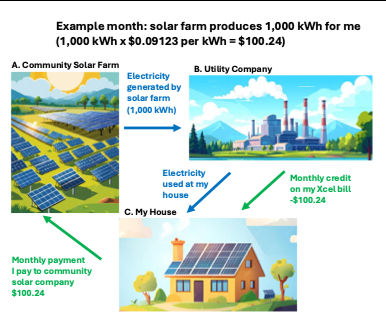
In 2025, we signed an agreement with SunShare, a community solar company doing business in Colorado. After analyzing our Xcel bills, SunShare calculated what fraction of one of their solar farms in Weld County they would attribute to us, enough to make up our home’s electricity gap. SunShare sends that attributed electricity to Xcel. Each month, SunShare reports to us how many kWh they provide to Xcel on our behalf. The dollar equivalent of the electricity that SunShare gives to Xcel shows up as a credit on our monthly Xcel bill and we pay that amount to SunShare.
The rate used for this credit is currently a little more than 9 cents per kWh. It is $0.09123 per kWh. For example, if one month, SunShare sends Xcel 1,000 kWh of electricity that is attributed to us, Xcel provides $100.24 credit on that month’s utility bill (1,000 kWh x $0.09123 per kWh = $100.24). In turn, we pay SunShare $100.24. The figure below shows this relationship.
Depending on when you get it and how much Xcel charges for your electricity, it may cost a little more or a little less to use community solar. Currently, Xcel’s flat electricity rates are $0.10380 per kWh in the summer (June–Sept) and $0.08570 per kWh in the winter (Oct–May). Xcel also has a new two-tiered time-of-use pricing. In winter, the two rates are $0.18331 per kWh (weekdays 5 pm to 9 pm) and $0.067926 per kWh (the rest of the time). Xcel’s time-of-use electricity rates are a little more during the summer.
This is one way people can make use of community solar as their electricity demand changes. Community solar farms help to prevent utilities from building more fossil fuel power plants by supplying them with emission-free solar energy equivalent to the energy used in our homes or apartments. This helps avoid the need to build the coal- or gas-powered generation the utility would use to power our homes or apartments.
Community solar may work well for people who cannot afford or cannot install solar panels. You can still make use of solar power even if you lack favorable sunshine, are a renter without control the building’s electricity source, or if there is some other reason. If you want to utilze solar energy instead of mixed fossil and renewable production, you can look to execute an agreement with a community solar company to provide your electricity from a solar farm.
In our agreement with SunShare, we can cancel with them so long as we give 3 months’ notice and not incur any cancellation fee. We may yet decide to add more rooftop solar panels and cancel our community solar agreement. Doing this would allow SunShare to re-allocate our fraction their solar farm to someone else who may need it more than us.